
67 companies with total debt of Rs 5.65 lakh cr were either loss-making or didn't generate enough profit to cover interest cost in FY15

Reports have suggested Rs 400-650 as the possible IPO price

Currently, TCS is India's second most valuable firm after Reliance Industries, which has a market cap of nearly Rs 12.9 trillion.

For top IT services firms, revenue growth in FY15 was the slowest since the Lehman crisis

Brokerages expect revenue growth at a 7-quarter high but profitability may disappoint.

While gold returned 12 per cent annual gain in 10 years, Nifty didn't exceed 9 per cent.

Analysts say traders have been building long positions on expectations the BJP would sail through in the five Assembly elections

Kotak Bank was the top gainer in the Sensex pack, ending 4.31 per cent higher. PowerGrid, TCS, ICICI Bank, SBI, HCL Tech, NTPC, Infosys, Bajaj Finance, HDFC duo, ONGC, Vedanta and IndusInd Bank too rose up to 2.84 per cent.

Second-tier NBFC stocks are trading at 24.4x their trailing earnings, which is nearly twice their 15-year average of 13.9x

Promoters' holding in private sector BSE 500 companies declined to 43.4% in Sept

The Hinduja Group, Mukesh Ambani, Murugappa, and the Adani groups were the other gainers in the Modi regime, while Naveen Jindal and Sun Pharma groups saw the most erosion in their m-cap in the last five years, reports Krishna Kant.

During the dot-com bubble, it had touched a high of 1.9.

A weaker rupee could aid corporate earnings through its positive impact on export intensive sectors such as information technology services, pharmaceuticals and commodity producers such as metal and mining, and oil and gas companies.

This measure will ensure that the price of a scrip cannot move upward or downward beyond a limit set for the day.

Despite the onset of wedding season, the situation in apparel retail market remained unchanged and saw sharp decline in sales

According to estimates, if the companies are not allowed to raise petrol rates at least Rs 5 a litre by the first fortnight of September, they might begin to suffer underrecoveries on this decontrolled auto fuel, too -- for the first time this financial year.

With India's imports exceeding exports, weak rupee does more harm than good. Analysts, however, say that rupee depriciation is positive for export-oriented sectors such as IT services, pharmaceuticals, textiles and automobiles

Investors are anxious over the US-China trade tension, a sharp devaluation in yuan and uncertainty over Kashmir issue.

Spiralling prices pinched the pocket of consumer as edible oil, fuel and many other commodities turned dearer this year amid pandemic-induced disruptions but the inflationary pressure is anticipated to ease, though marginally, in the coming months. As consumers, at retail as well as wholesale levels, are willy-nilly learning to live with the new normal of curbs to contain the spread of coronavirus infections, experts are of the view that elevated inflation is likely to stay longer. After dealing with the devastating blows from the second COVID wave, especially during the April-June period, the economy is well on the revival path but the emergence of Omicron might unsettle the recovery trajectory in the short term.

Corporate indebtedness is now twice what it was before the global financial crisis; banks' bad loans ratio is 3.5 times higher.

If financials and oil sectors were removed, India Inc has done quite well.

More than half the Sensex companies have declared their results for the third quarter and there are more positive surprises than disappointments.

In five years, per-employee revenue for IT companies grew at 9 per cent each year.

The combined share of customs and excise duties, service tax, and value-added tax in India's gross domestic product reached an all-time high of 10.5%.

World trade has been growing slower than world GDP since 2012.

'Investors should plan and make investments strictly on the basis of their risk profile.' 'They should not bite more than they can chew.'

The retail inflation, which is factored in by the RBI to arrive at its monetary policy, has been on decline since last month. The previous low was 5.54 per cent in November 2019. The government has asked the RBI to restrict the inflation around 4 per cent, with a margin of 2 per cent on the either side.

Check out some of the stocks that will react on the basis of their numbers in the near term.

Centre took Rs 1,002 bn from here in 2017-18, sharply up from Rs 904 bn a year before and Rs 123.6 bn in FY14

There was broad-based rally with participation across sectors creating enormous wealth for investors but starting 2018, the rally got concentrated into select large-cap companies with under performance in broader markets.

Oil and gas sectot may not put up good numbers in Q4.
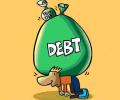
In the past three years, personal loans have grown at twice the rate of growth in personal disposable income, leading to a steady rise in household indebtedness. At the end of March this year, Indians owed Rs 25.2 lakh crore to banks and listed non-banking finance companies (NBFCs), up 65 per cent in the past three years.

The turmoil on the Street and a continued fall of the rupee may affect growth stocks, pushing equity investors back to the relative safety of defensive counters, or forcing them to flee markets, or both.

Besides foreign flows, corporate earnings and US Federal Reserve chief Janet Yellen's testimony to the nation's legislature are also likely to impact investor sentiment.

Crisis of growth is worsened by the challenging global environment and policy missteps. Returning to 9 per cent growth trajectory will be a tall order.

Combined debt-equity ratio of top companies declines but interest expenses outgrow profits.
.jpg)
Investors often forget that the movements in indices such as the Sensex reflects the performance of its constituent stocks; nothing else.

HUL, UltraTech, Asian Paints, L&T, HDFC Bank top global valuation charts

With mutual funds, promoters turning net-buyers, foreign investors may have to bid up prices to raise holdings.

Axis Bank's acquisition of Citibank's consumer finance business for Rs 12,325 crore - the second biggest deal in the Indian banking sector - is seen as a good deal at a good price. The acquisition enables Axis Bank to close the gap with competition in some key segments such as credit cards. At the same time, there are some key issues that are crucial for the deal's success, apart from the fact that it will take some time for Axis to reap the full harvest of its investment.
 © 2026 Rediff.com - Advertise with us - Disclaimer - Privacy Policy - Sitemap - Feedback - About us - Terms of use - Grievances